
Netty 介绍
2025年7月10日大约 5 分钟
netty版本: 3.x、4.x、4.x
应用领域:
- 分布式进程通信 如:hadoop、dubbo、akka等具有分布式功能的框架,底层RPC通信都是基于netty实现的,这些框架版本通常都还在用netty3.x(2019年2月10日)
- 游戏服务器开发 最新的游戏服务器都有部分公司可能已经开始采用 netty4.x 或者 netty5.x
alternative
- Mina
参考
- 概念:netty 核心概念 https://www.javaspring.net/blog/java-netty/
- 概念:EventLoop https://zhuanlan.zhihu.com/p/666030635
- 文档:netty 官方文档 https://netty.io/wiki/
- netty rpc 实现 https://www.bilibili.com/video/av44457831/
资料 https://www.jianshu.com/p/b0343bfd216e - rpc 介绍 https://www.jianshu.com/p/b0343bfd216e
概念
- 事件驱动模型(Event-Driven Model)
- Reactor线程模型
- 事件循环执行器(EventLoop implement ScheduleExecutorService) —— 负责 I/O 事件的分发
- 当客户端与服务端建立连接后,服务端会创建一个 Channel,并将该 Channel 与 EventLoop 绑定。绑定后,该 Channel 在整个生命周期内所有发生的事件都由该 EventLoop 来处理。
- 但是一个 EventLoop 可以绑定多个 Channel。对于 EventLoop 而言,它就是通过不断循环它所绑定的 Channel 事件列表,检测是否有事件发生,如果有,则将该事件分发给 worker 线程处理。
- EventLoopGroup —— 一组 EventLoop ,它主要是来维护和管理 EventLoop,一般我们是不会直接使用 EventLoop 的,而是通过 EventLoopGroup 来使用它。
register():当服务端创建一个 Channel 后,会调用该方法将 Channel 绑定到其中一个 EventLoop 上。next():返回 EventLoopGroup 中维护的 EventLoop。
- 事件循环执行器(EventLoop implement ScheduleExecutorService) —— 负责 I/O 事件的分发
- Reactor线程模型
- 频道(Channel) —— 事件(Event)总线。频道两端绑定一个服务端、一个客户端,是双方数据读写的最大可见部分
- 当channel完成register、active、read、readComplete等操作时,会触发pipeline的相应方法
- fireChannelRegistered —— 找到next的channel,调用其register方法
- fireChannelActive —— 同上
- fireChannelRead —— 同上
- fireChannelReadComplete —— 同上
- 当channel完成register、active、read、readComplete等操作时,会触发pipeline的相应方法
- 管道(ChannelPipeline) —— 保存一组编排好的频道处理器(ChannelHandler)。当事件(Event)到达频道(Channel)后,事件被会交由管道处理,管道会按其编排好的处理器顺序有序触发事件处理。
- 频道处理器(ChannelHandler) —— 对事件处理的机制(mechanism)实现
- ChannelInboundHandler —— 处理进入的数据
- ChannelInboundHandlerAdapter
- SimpleChannelInboundHandler
- 自动泛型转换
- 自动资源释放
- SimpleChannelInboundHandler
- ChannelInboundHandlerAdapter
- ChannelOutboundHandler —— 处理发出的数据
- ChannelInboundHandler —— 处理进入的数据
- ByteBuf —— buffer,读写事件数据的中间介质
Demo
基本使用:客户端、服务端(3.10.5.Final)
依赖
<dependencies>
  <!-- https://mvnrepository.com/artifact/io.netty/netty -->
  <dependency>
    <groupId>io.netty</groupId>
    <artifactId>netty</artifactId>
    <version>3.10.5.Final</version>
  </dependency>
</dependencies>
Server
入口
package cn.edut.server;

import java.net.InetSocketAddress;
import java.util.concurrent.ExecutorService;
import java.util.concurrent.Executors;

import org.jboss.netty.bootstrap.ServerBootstrap;
import org.jboss.netty.channel.ChannelPipeline;
import org.jboss.netty.channel.ChannelPipelineFactory;
import org.jboss.netty.channel.Channels;
import org.jboss.netty.channel.socket.nio.NioServerSocketChannelFactory;

public class Server {

  public static void main(String[] args) {
    // 服务类
    ServerBootstrap bootstrap = new ServerBootstrap();

    ExecutorService bossExecutor = Executors.newCachedThreadPool();
    ExecutorService workerExecutor = Executors.newCachedThreadPool();

    // 设置niosocket工厂
    bootstrap.setFactory(new NioServerSocketChannelFactory(bossExecutor, workerExecutor));

    // 设置管道的工厂
    bootstrap.setPipelineFactory(new ChannelPipelineFactory() {
      // 管道可以理解为:一堆过滤器
      @Override
      public ChannelPipeline getPipeline() throws Exception {
        // 通常服务类都是xxx+s,如channels
        ChannelPipeline pipeline = Channels.pipeline();
        // 添加handler
        pipeline.addLast("helloHandler", new HelloHandler());
        return pipeline;
      }
    });

    // 为服务类绑定端口
    bootstrap.bind(new InetSocketAddress(10101));

    System.out.println("服务启动!");
  }
}
处理器
package cn.edut.server;

import org.jboss.netty.channel.ChannelHandlerContext;
import org.jboss.netty.channel.ChannelStateEvent;
import org.jboss.netty.channel.ExceptionEvent;
import org.jboss.netty.channel.MessageEvent;
import org.jboss.netty.channel.SimpleChannelHandler;

public class HelloHandler extends SimpleChannelHandler {

  @Override
  public void messageReceived(ChannelHandlerContext ctx, MessageEvent e) throws Exception {
    System.out.println("MessageEvent:"+e);
    System.out.println("messageReceived");
    super.messageReceived(ctx, e);
  }

  @Override
  public void exceptionCaught(ChannelHandlerContext ctx, ExceptionEvent e) throws Exception {
    System.out.println("exceptionCaught");
    super.exceptionCaught(ctx, e);
  }

  @Override
  public void channelConnected(ChannelHandlerContext ctx, ChannelStateEvent e) throws Exception {
    System.out.println("channelConnected");
    super.channelConnected(ctx, e);
  }

  @Override
  public void channelDisconnected(ChannelHandlerContext ctx, ChannelStateEvent e) throws Exception {
    System.out.println("channelDisconnected");
    super.channelDisconnected(ctx, e);
  }

  @Override
  public void channelClosed(ChannelHandlerContext ctx, ChannelStateEvent e) throws Exception {
    System.out.println("channelClosed");
    super.channelClosed(ctx, e);
  }

}
channelClosed和channelDisconnected的区别:
channelClosed: channel 关闭的时候就触发channelDisconnected:必须是连接已经建立,关闭通道的时候才会触发
解码器
手写解码器
  @Override
  public void messageReceived(ChannelHandlerContext ctx, MessageEvent e) throws Exception {
    System.out.println("messageReceived");
    System.out.println("MessageEvent:"+e);

    //获取客户端信息
    ChannelBuffer buffer = (ChannelBuffer) e.getMessage();
    System.out.println("message:"+new String(buffer.array()));

    super.messageReceived(ctx, e);
  }
一般不手写,而是使用内置StringDecoder、StringEncoder处理器类
  @Override
  public void messageReceived(ChannelHandlerContext ctx, MessageEvent e) throws Exception {
    System.out.println("messageReceived");
    System.out.println("MessageEvent:" + e);

    // 获取客户端信息
    String message = (String) e.getMessage();
    System.out.println("message:" + message);

    // // 回写数据
    // ChannelBuffer copiedBuffer = ChannelBuffers.copiedBuffer("hi from server".getBytes());
    // ctx.getChannel().write(copiedBuffer);

    super.messageReceived(ctx, e);
  }
Client
入口
package cn.edut.client;

import java.net.InetSocketAddress;
import java.util.Scanner;
import java.util.concurrent.ExecutorService;
import java.util.concurrent.Executors;

import org.jboss.netty.bootstrap.ClientBootstrap;
import org.jboss.netty.channel.Channel;
import org.jboss.netty.channel.ChannelFuture;
import org.jboss.netty.channel.ChannelPipeline;
import org.jboss.netty.channel.ChannelPipelineFactory;
import org.jboss.netty.channel.Channels;
import org.jboss.netty.channel.socket.nio.NioClientSocketChannelFactory;
import org.jboss.netty.channel.socket.nio.NioServerSocketChannelFactory;
import org.jboss.netty.handler.codec.string.StringDecoder;
import org.jboss.netty.handler.codec.string.StringEncoder;

public class Client {

  public static void main(String[] args) {
    // 服务类
    ClientBootstrap bootstrap = new ClientBootstrap();

    // 线程池
    ExecutorService bossExecutor = Executors.newCachedThreadPool();
    ExecutorService workerExecutor = Executors.newCachedThreadPool();

    // socket工厂
    bootstrap.setFactory(new NioClientSocketChannelFactory(bossExecutor, workerExecutor));

    // 管道工厂
    bootstrap.setPipelineFactory(new ChannelPipelineFactory() {
      @Override
      public ChannelPipeline getPipeline() throws Exception {
        ChannelPipeline pipeline = Channels.pipeline();
        pipeline.addLast("decoder", new StringDecoder());
        pipeline.addLast("encoder", new StringEncoder());
        pipeline.addLast("hiHandler", new HiHandler());
        return pipeline;
      }
    });

    // 连接服务端
    ChannelFuture connect = bootstrap.connect(new InetSocketAddress("127.0.0.1",10101));
    Channel channel = connect.getChannel();

    System.out.println("client start");

    Scanner scanner = new Scanner(System.in);
    while(true) {
      System.out.println("请输入:");
      channel.write(scanner.nextLine());
    }
  }

}
处理器
package cn.edut.client;

import org.jboss.netty.channel.ChannelHandlerContext;
import org.jboss.netty.channel.ChannelStateEvent;
import org.jboss.netty.channel.ExceptionEvent;
import org.jboss.netty.channel.MessageEvent;
import org.jboss.netty.channel.SimpleChannelHandler;

public class HiHandler extends SimpleChannelHandler {
  @Override
  public void messageReceived(ChannelHandlerContext ctx, MessageEvent e) throws Exception {
    System.out.println("messageReceived");
    System.out.println("MessageEvent:" + e);

    // 获取服务端信息
    String message = (String) e.getMessage();
    System.out.println("message:" + message);
    super.messageReceived(ctx, e);
  }

  @Override
  public void exceptionCaught(ChannelHandlerContext ctx, ExceptionEvent e) throws Exception {
    System.out.println("exceptionCaught");
    super.exceptionCaught(ctx, e);
  }

  @Override
  public void channelConnected(ChannelHandlerContext ctx, ChannelStateEvent e) throws Exception {
    System.out.println("channelConnected");
    super.channelConnected(ctx, e);
  }

  @Override
  public void channelDisconnected(ChannelHandlerContext ctx, ChannelStateEvent e) throws Exception {
    System.out.println("channelDisconnected");
    super.channelDisconnected(ctx, e);
  }

  @Override
  public void channelClosed(ChannelHandlerContext ctx, ChannelStateEvent e) throws Exception {
    System.out.println("channelClosed");
    super.channelClosed(ctx, e);
  }
}
基本使用:服务端
https://github.com/LawssssCat/blog/tree/master/code/demo-java-thread/demo-01-nio-netty- io.netty.channel.nio.NioEventLoopGroup —— 线程池
todo public static AttributeKey<HttpSession> SESSION_KEY = AttributeKey.valueOf("session");
todo ChannelInboundHandlerAdapter
网络握手
TCP/IP 建立连接的三个阶段被称为“三次握手”,三次握手完成后,客户端和服务端建立连接,开始传输数据。
- A:
SYN—— 客户端发起同步请求。你好呀,听说你开启了监听端口,我想给你传数据,方便建立连接吗,我先发一个序列号x? - B:
SYN + ACK—— 服务端发起同步请求。是的呀,我给你发一个我的序列号y,对了,你的下一个序列号是x+1吗? - A:
ACK—— 客户端确认请求,对着呢,你的下一个序列号y+1吗?
这三轮同步和确认操作后,客户端和服务器端就建立起了稳定的连接。
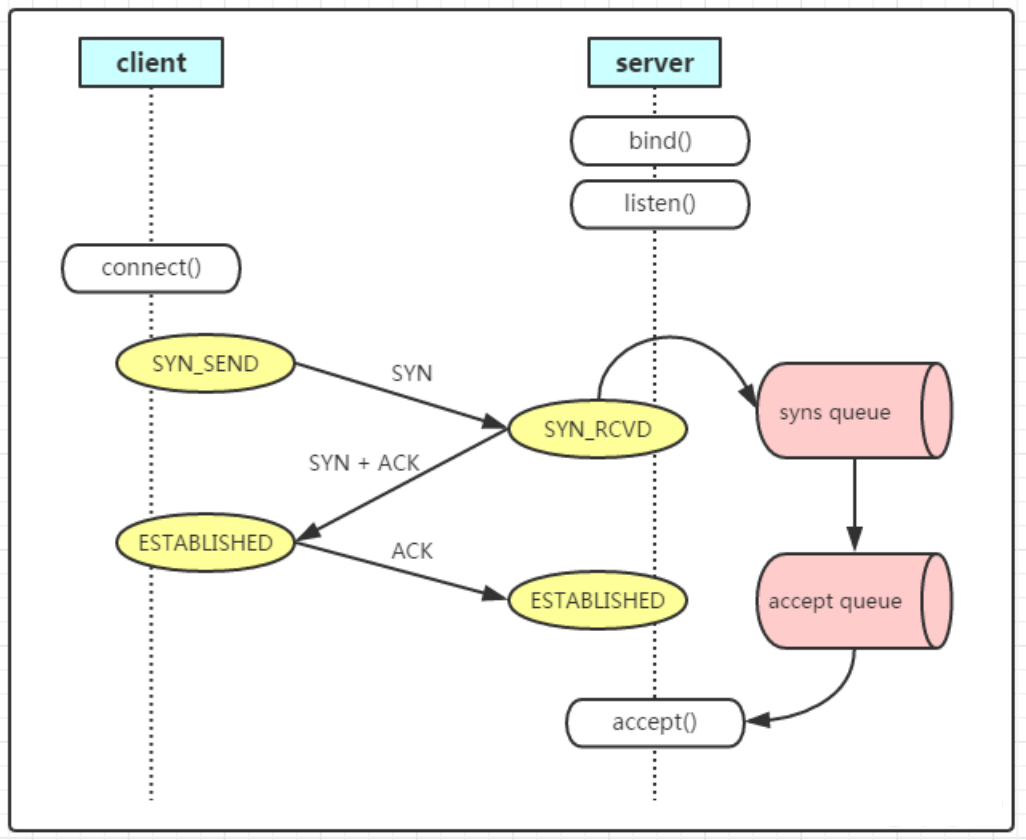
这个过程中,netty服务器内核会用到两个队列:
- sync queue: 未完成三次握手的连接,内核正等待连接建立,记作 A 队列;
- accept queue: 已完成三次握手,内核正等待进程执行 accept 函数的连接,记作 B 队列。
ChannelOption.SO_BACKLOG 配置就是控制 A + B 队列总长度的参数,如果这两个队列都满了,那么 Netty 服务将不会再接收新的连接请求了。